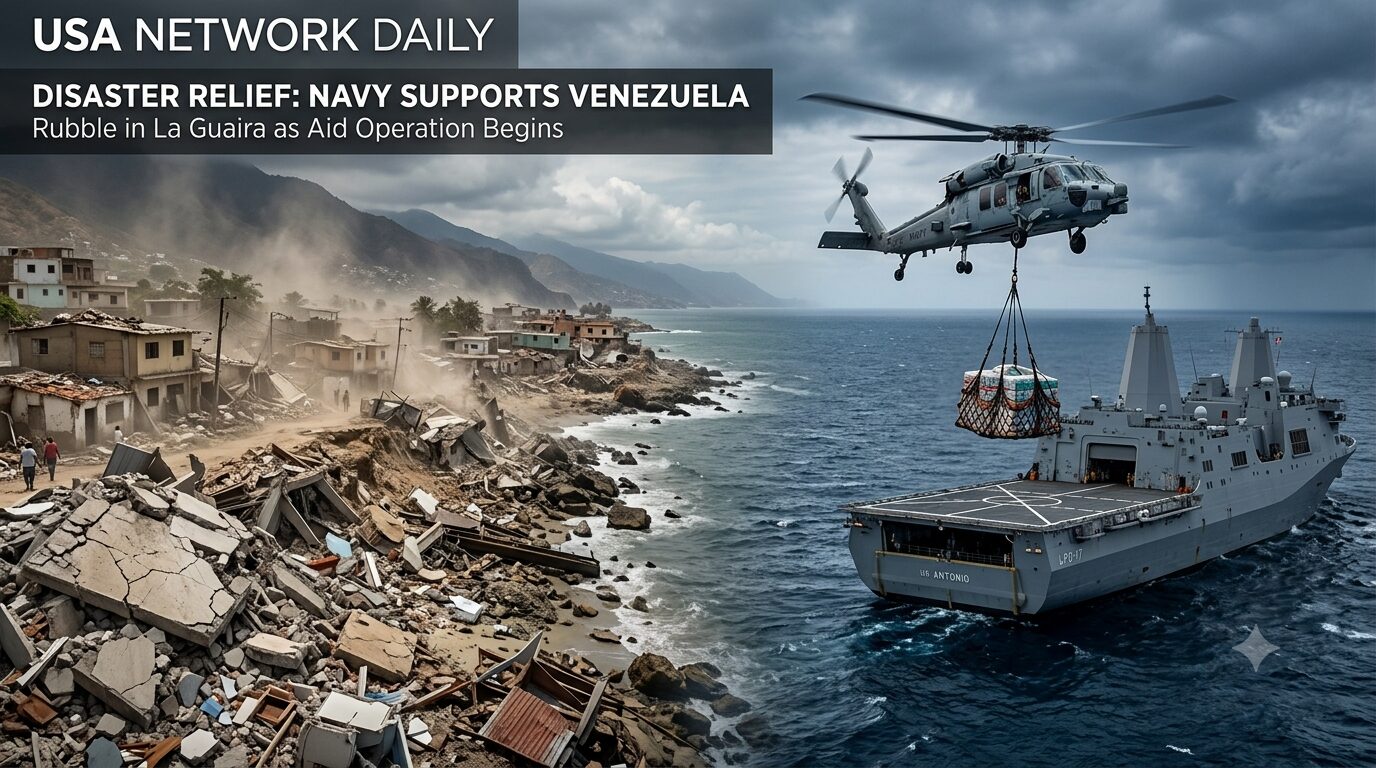

When a massive natural disaster strikes a region already strained by severe economic instability, the immediate challenge is rarely just about gathering emergency supplies. Instead, the real bottleneck is logistics—how to physically deliver food, clean water, and medical personnel through a landscape of shattered roads, broken bridges, and collapsed communication networks.
This was the exact crisis that unfolded on June 24, 2026, when two powerful “doublet” earthquakes struck north-central Venezuela in rapid succession. The back-to-back tectonic shocks—measuring magnitudes of 7.2 and 7.5—devastated local infrastructure, particularly along the coast of La Guaira where roughly 80% of buildings collapsed.
With roads blocked by massive landslides and local airports crippled, the international humanitarian community had to throw out the traditional land-based disaster playbook. What emerged was a highly adaptive, sea-backed Venezuela earthquake response that bypassed ruined infrastructure entirely to deliver life-saving aid from the ocean.
The Doublet Threat: Why the Damage Was So Severe
The June 24 disaster was not a typical mainshock followed by minor aftershocks. It was a rare geological event known as a doublet—two distinct, massive earthquakes occurring along the plate boundary zone near the San Sebastián fault system less than a minute apart.
The first 7.2 earthquake compromised the structural integrity of buildings. When the second 7.5 shock hit just 39 seconds later, it triggered widespread collapses of structures that might have survived a single tremor.
THE ANATOMY OF A SEISMIC DOUBLET
First Shock: 7.2 Mw ──── (39 Seconds of Structural Strain)
[Second Shock: 7.5 Mw] Result: Immediate collapse of weakened concrete structures, trapping thousands.
The physical toll was immediate: thousands of fatalities, over 16,000 injuries, and tens of thousands of displaced families. Local hospitals, already struggling under chronic resource shortages, were completely overwhelmed within hours.
Shifting the Staging Ground to the Sea
With land corridors blocked and local ports heavily damaged, relief coordinators recognized that forcing heavy cargo through traditional channels would create bottleneck delays. Emergency planners shifted the entire staging ground of the mission offshore.
By utilizing amphibious naval vessels stationed off the coast of La Guaira, the rescue operations remained entirely self-sustaining. This ocean-based strategy offered several distinct advantages:
- Zero Footprint on Damaged Land: Heavily loaded helicopters and tiltrotor aircraft launched directly from ship decks, landing on beaches or in cleared inland parks without requiring local power grids or intact runways.
- Independent Medical and Communication Hubs: Floating naval platforms served as offshore triage facilities and clean, high-bandwidth communication centers, completely independent of the damaged local grid.
- Rapid Heavy-Lift Capabilities: Heavy-lift military helicopters worked alongside civilian cargo systems to ferry heavy machinery, search dogs, and specialized rescue teams directly to the most critical rubble piles.
Tech and Coordinated Funding: The True Catalysts
While heavy machinery cleared physical paths, modern technology solved the communication vacuum. In the immediate aftermath of the quakes, power outages and downed cell towers cut off survivors and localized first responders.
To bridge this critical gap, emergency teams deployed low-Earth orbit satellite internet terminals. Setting up these portable satellite hubs in affected communities allowed local doctors, search-and-rescue teams, and international humanitarian agencies to map the destruction in real time and coordinate their search efforts.
Simultaneously, a massive surge of international funding began flowing toward non-governmental organizations (NGOs) and international bodies. This multi-layered funding structure ensured that while military assets managed the heavy physical logistics, civilian groups could focus directly on long-term public health, shelter, and water sanitation.
Long-Term Recovery and Lessons Learned
As the active search-and-rescue phase transitions into a long-term rebuilding effort, the true scale of the recovery challenge is becoming clear. Re-establishing clean water lines, preventing disease outbreaks in temporary camps, and reconstructing thousands of destroyed homes will take years.
Yet, the success of the initial sea-backed logistics operation offers a powerful blueprint for future global crisis management. When land-based infrastructure completely fails, the ocean can serve as a vital, self-sustaining highway for hope.our latest health news and fitness guides
FAQ
What is a “doublet” earthquake?
A doublet earthquake refers to two major earthquakes of similar magnitude that occur very close to each other in both time and location. Because the second shock hits before emergency teams can react or buildings can be stabilized, the cumulative damage is often far worse than a single seismic event.
Why was sea-based logistics so important in this disaster?
The earthquakes caused major landslides and cracked runways, making it highly dangerous or impossible to transport large quantities of aid via land or traditional air cargo. Utilizing offshore ships allowed rescue teams to bypass these bottlenecks by flying helicopters and tiltrotor aircraft directly into isolated communities.
How did rescue teams communicate if the local power grid was down?
Relief agencies deployed portable satellite internet terminals to the hardest-hit areas. These low-Earth orbit satellite units provided immediate, reliable internet connections, allowing doctors, engineers, and search teams to share data and requests for help without relying on local cell towers.
Where does the international aid money go?
To ensure transparency and immediate community impact, international aid is routed through major humanitarian groups like the United Nations, the Pan American Health Organization (PAHO), and verified non-governmental organizations (NGOs) working directly on the ground.
-
Read the Original Investigation: For the original detailed coverage of this emergency, see The Atlantic: US-Venezuela Earthquake Response.
-
UN OCHA Response Efforts: Read the official updates and logistics reports via the United Nations OCHA Media Centre.