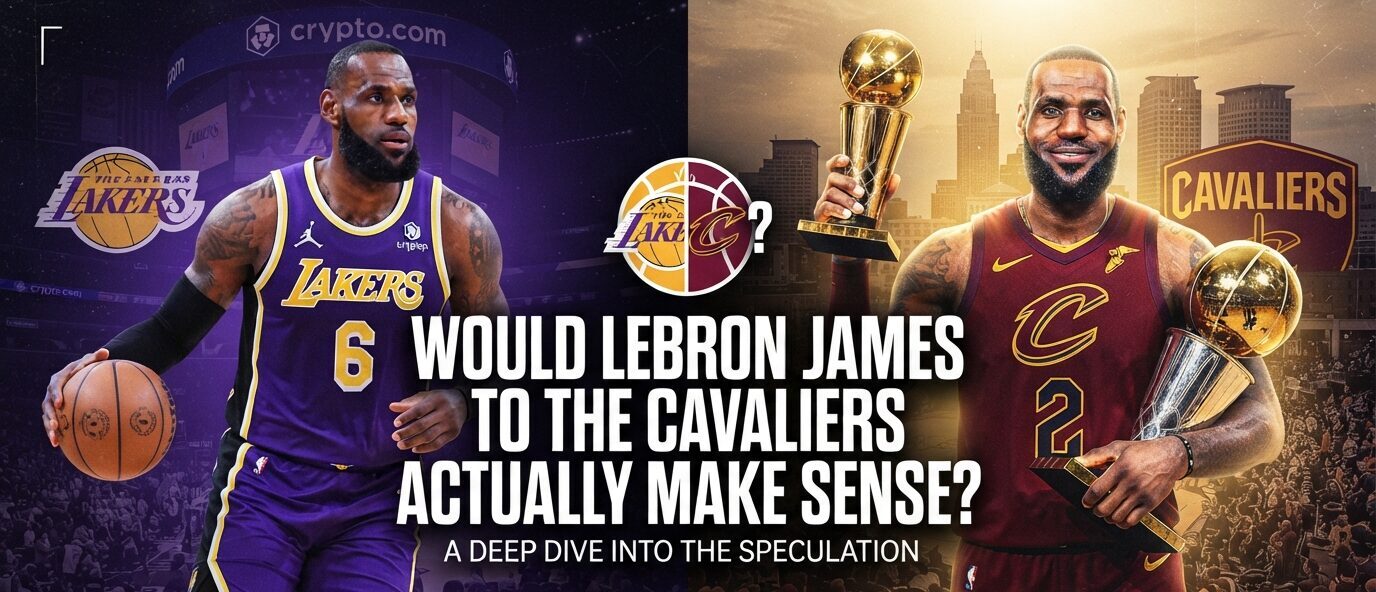

James Harden wants it. Cleveland fans have wanted it for years. And now it’s starting to feel less like a fantasy and more like a real possibility: LeBron James, back with the Cleveland Cavaliers, for what would presumably be the final chapter of his career.
Harden made the pitch pretty explicitly in a video posted this past week. “I hope he comes to Cleveland,” Harden said. “It’s a perfect storybook finish. He’s at home for his last year.” It’s a good line. But good lines don’t win basketball games, and cap sheets don’t care about storybook endings. So let’s actually look at whether this move makes sense — for both sides.
Why It Makes Sense on Paper
Start with the obvious: LeBron is from Akron. He was drafted No. 1 overall by Cleveland in 2003, spent his first seven seasons there, came back for a second stint, and delivered the city its first major sports championship in over 50 years in 2016. If any “hometown return” narrative in sports carries real weight, it’s this one.
Then there’s the roster. Cleveland just made the Eastern Conference Finals, even though they were swept by the Knicks. The core is already solid: Harden running the offense, Donovan Mitchell scoring, and Evan Mobley and Jarrett Allen anchoring the frontcourt. That’s not a rebuilding situation LeBron would be walking into. It’s a team one or two pieces away from real contention — exactly the kind of situation he’s chased for the last several years.
And critically, reports suggest LeBron isn’t chasing money at this stage of his career. If that’s true, it removes the biggest obstacle to almost any reunion: Cleveland doesn’t need max cap space to make this work, because he’s reportedly willing to sign for close to the veteran’s minimum.
“I hope he comes to Cleveland,” – James Harden wants to play with LeBron James on the Cavs 🔥🔥🔥 pic.twitter.com/0776ymDfQZ
— ESPN Cleveland (@ESPNCleveland) July 17, 2026
Why It’s Not That Simple
Here’s where the storybook version runs into actual NBA finance.
Cleveland currently sits about $25 million below the first tax apron — but that number doesn’t yet account for Harden’s next contract. He declined a $42.3 million player option, and he’s reportedly holding off on re-signing specifically to give the Cavs more flexibility to chase LeBron. That’s a good sign for Cleveland’s intentions, but it also means the front office is threading a needle: keep Harden happy, keep Mitchell and the core intact, and still find room for a 40-year-old superstar without blowing past the tax apron and triggering a hard cap.
Practically, that likely means Cleveland has to move money elsewhere. Dennis Schroder or Max Strus are the two names that come up most in cap breakdowns as trade candidates to free up additional space. None of that is dealbreaking, but it’s not as simple as “LeBron says yes, Cleveland says yes, done.” There’s real roster math involved.
The Bigger Question: Does Cleveland Even Need Him?
This is the part that gets skipped in the excitement. Cleveland made the Conference Finals without LeBron. Their issue against New York wasn’t a lack of star power — it was getting swept by a team that outplayed them in exactly the areas LeBron, at this stage of his career, can’t fully fix on his own: perimeter defense and depth.
Adding a 40-year-old LeBron, even at a bargain price, means managing his minutes carefully during the regular season, which puts more pressure on an already stretched bench. It also means finding shots for a fourth ball-dominant scorer alongside Harden and Mitchell, both of whom need the ball in their hands to be effective. Roster fit isn’t automatic just because the name is LeBron James.
What the Other Suitors Bring
Cleveland isn’t operating in a vacuum here. The Miami Heat, Golden State Warriors, and Philadelphia 76ers are reportedly in the same tier of serious suitors. The Warriors’ pitch is arguably the most aggressive — Draymond Green opted out of a guaranteed $27.7 million to help Golden State create the cap room to make LeBron an offer through their mid-level exception. That’s a franchise explicitly restructuring around the idea of adding him, not just hoping he shows up.
Philadelphia can only offer the bare veteran’s minimum, which likely takes them out of serious contention if money matters at all, even marginally. Miami’s fit is less clear from a roster-construction standpoint, but Pat Riley’s front office has a track record of making things work when a star wants in.
So, Does It Make Sense?
Emotionally, yes — this is about as clean a full-circle story as professional sports offers. Financially, it’s workable, especially if LeBron really is willing to take a below-market deal. Basketball-wise, it’s more complicated than the highlight-reel version suggests. Cleveland’s issue last postseason wasn’t a lack of a superstar; it was depth and matchup problems that a 40-year-old, even a great one, only partially solves.
The honest read: this move makes more sense as a legacy decision than a pure basketball one. That’s not a criticism — plenty of great NBA stories aren’t purely about basketball logic. But anyone expecting a LeBron-to-Cleveland reunion to instantly fix what went wrong against the Knicks might be setting themselves up for disappointment. Sometimes the storybook ending and the optimal roster decision just aren’t the same thing.
For a deeper look at what Cleveland actually needs to fix heading into next season — with or without LeBron — see our full Cleveland Cavaliers 2026-27 season preview.
Sources: Bleacher Report, ESPN, CBS Sports.