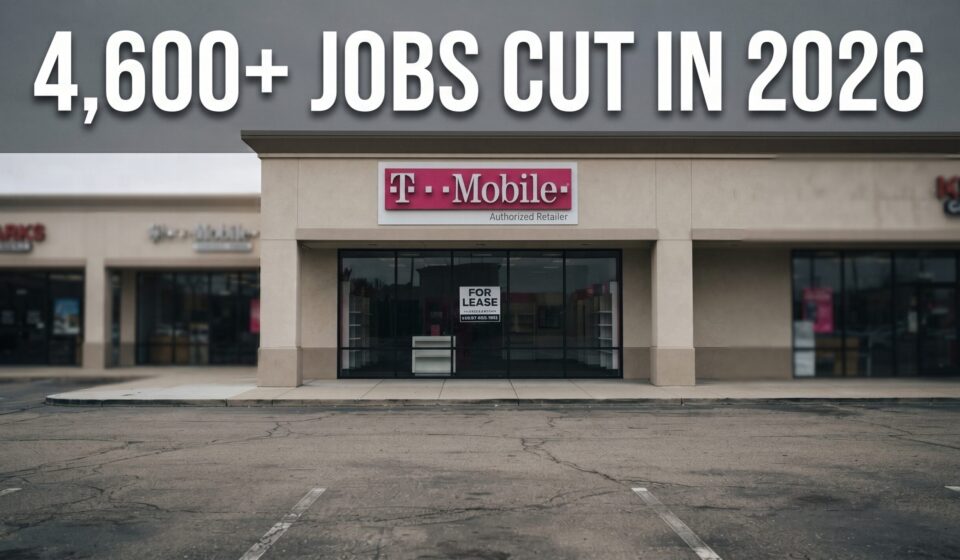

T-Mobile isn’t slowing down its shift away from traditional retail. The carrier continues to shut down stores and cut staff as it pushes toward becoming a digital-first company, according to a new report from PhoneArena.
The company just filed another round of layoff notices. This time, 77 jobs in Washington state are on the chopping block, hitting retail locations, headquarters staff, and even remote employees.
What’s actually being cut
The layoffs will happen in phases between September 21 and November 18, 2026. T-Mobile says the cuts come down to “changing business needs.”
The roles being eliminated span a wide range. Frontline retail workers are losing their jobs right alongside senior corporate directors and system architects. A corporate office in Bothell, Washington, called Canyon Pointe, is closing entirely.
Seven Washington stores are shutting their doors too, stretching from Bellingham to Yakima. Some employees may be offered the chance to relocate, but many won’t have that option.
This is part of something much bigger
These 77 jobs are a small piece of a much larger picture. T-Mobile’s total U.S. headcount dropped by 4,671 employees between December 2025 and June 2026 alone. That’s a 6.7% reduction, according to Fierce Network’s reporting on Deutsche Telekom’s earnings filing.
To put that in perspective, T-Mobile had 70,036 U.S. employees at the end of 2025. By mid-2026, that number had fallen to 65,365.
The company calls this its “Workforce Transformation.” In plain terms, it means centralizing leadership, cutting management layers, and eliminating roles that overlap across departments. T-Mobile recorded $141 million in restructuring charges just in the first half of 2026, plus another $108 million in the second quarter tied specifically to retail changes.
Why this is happening
T-Mobile is betting big on its T-Life app. More customers are handling their accounts, upgrades, and bill payments digitally, so the company sees less need for as many physical stores as it used to run.
CEO Srini Gopalan, who took over the role in November, is leading the restructuring push. It’s a strategy shift that started building in late 2025 and has continued rolling out in waves ever since.
Despite the cuts, T-Mobile isn’t struggling financially. The company repurchased $7.1 billion of its own stock in just the first six months of 2026. That’s a detail worth sitting with. The layoffs aren’t happening because T-Mobile is in trouble. They’re happening because the company is reshaping what it wants to look like going forward, and physical stores and a bigger headcount aren’t part of that plan the way they used to be.
A trend bigger than just T-Mobile
T-Mobile isn’t alone here. Layoffs tied to automation, AI, and cost-cutting have been climbing across corporate America this year, according to tracking from Challenger, Gray & Christmas. Retailers and telecom companies in particular have been shrinking their physical footprints as more business shifts online.
For now, T-Mobile says it’s still evaluating whether more restructuring is coming. That means more store closures and job cuts down the line aren’t off the table.
If you shop at a T-Mobile store regularly, it may be worth checking whether your local location is one of the ones affected before you plan your next visit.