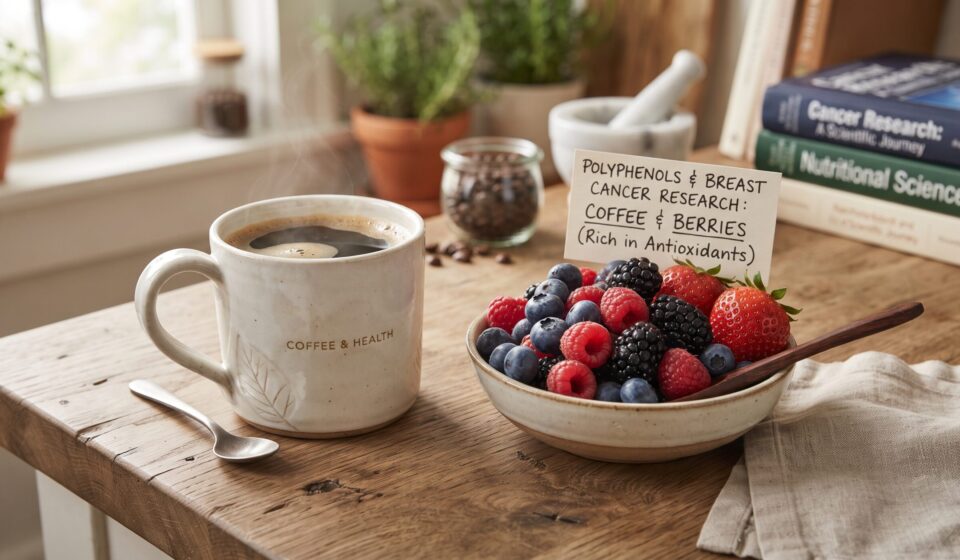
Can Your Morning Coffee Actually Lower Breast Cancer Risk? Here’s What the Research Really Says

I’ll be honest, I read headlines like “coffee lowers cancer risk” the same way I read headlines like “wine is good for your heart.” With a raised eyebrow. But this one is worth a closer look, because the study behind it is more specific and more interesting than the headline makes it sound.
What the new study actually found
Researchers followed 95 women diagnosed with breast cancer for an average of 11.5 years. That’s a long follow up period for a nutrition study, which matters. They tracked how much of a plant compound called polyphenols each woman consumed, according to Medical News Today’s coverage.
Polyphenols are the antioxidant compounds found in coffee, tea, berries, and a bunch of other plant foods. The women who consumed more of them, specifically two types called phenolic acids and lignans, had lower rates of breast cancer recurrence and death.
The numbers are notable. According to a breakdown from Tea & Coffee Trade Journal, higher phenolic acid intake was linked to a 65% lower recurrence rate. Total polyphenol intake was also tied to longer survival overall.
So where does coffee fit in? Coffee turned out to be one of the biggest dietary sources of these compounds for the women in the study. That’s the real headline here. Not “coffee cures cancer,” but “coffee is a major delivery vehicle for a compound that seems to matter.”
Before you get too excited
Here’s where I have to be the annoying one. This study had 95 people in it. That’s a small sample. And it’s observational, meaning researchers watched what people already ate and drank, they didn’t run a controlled experiment where one group got extra polyphenols and another didn’t.
That distinction matters a lot. Observational studies are great at spotting patterns, but they’re bad at proving cause and effect. Women who drink more coffee and eat more polyphenol rich foods might also exercise more, smoke less, or have other habits that explain the lower risk, not the coffee itself.
And this isn’t the only recent word on the subject. A much larger European study, the EPIC cohort, looked at polyphenol intake and breast cancer risk and found no clear association at all. Different outcome (that study looked at getting cancer in the first place, not recurrence after diagnosis), but it’s a reminder that this research area is still genuinely mixed.
Other long running research adds more nuance. A separate analysis of the EPIC cohort focused specifically on coffee found that higher caffeinated coffee intake was linked to a modest drop in postmenopausal breast cancer risk, but only for one specific hormone receptor subtype. Decaf showed no such link. In other words, even within “coffee and breast cancer” as a topic, the effect seems to depend heavily on the type of cancer, the type of coffee, and who’s drinking it.
So should you drink more coffee?
I’m not going to tell you to change your coffee habits based on one 95 person study, and honestly, neither should any responsible health researcher. But I also don’t think this is nothing.
What it does support is something doctors have been saying for years without needing a headline to back it up. A diet rich in polyphenols, found in coffee, tea, berries, olive oil, and vegetables like broccoli and onions, is consistently linked to better health outcomes across a bunch of different studies. Coffee just happens to be one of the easiest ways most people already get a dose of it.
If you already drink coffee and enjoy it, this is a reason to feel a little better about the habit, not a reason to suddenly triple your intake. If you don’t drink coffee, this study alone isn’t a strong enough reason to start.
For more research backed health stories like this one, you can check out our full health coverage.
The bigger picture
Nutrition science moves slowly and rarely gives us a clean, single answer. This study adds a genuinely interesting data point to a much larger, messier picture. Other researchers have found the opposite in bigger populations. That’s not a contradiction, it’s just how science actually works. One study is a clue, not a verdict.
So drink your coffee if you like it. Just don’t expect it to do the heavy lifting on its own.