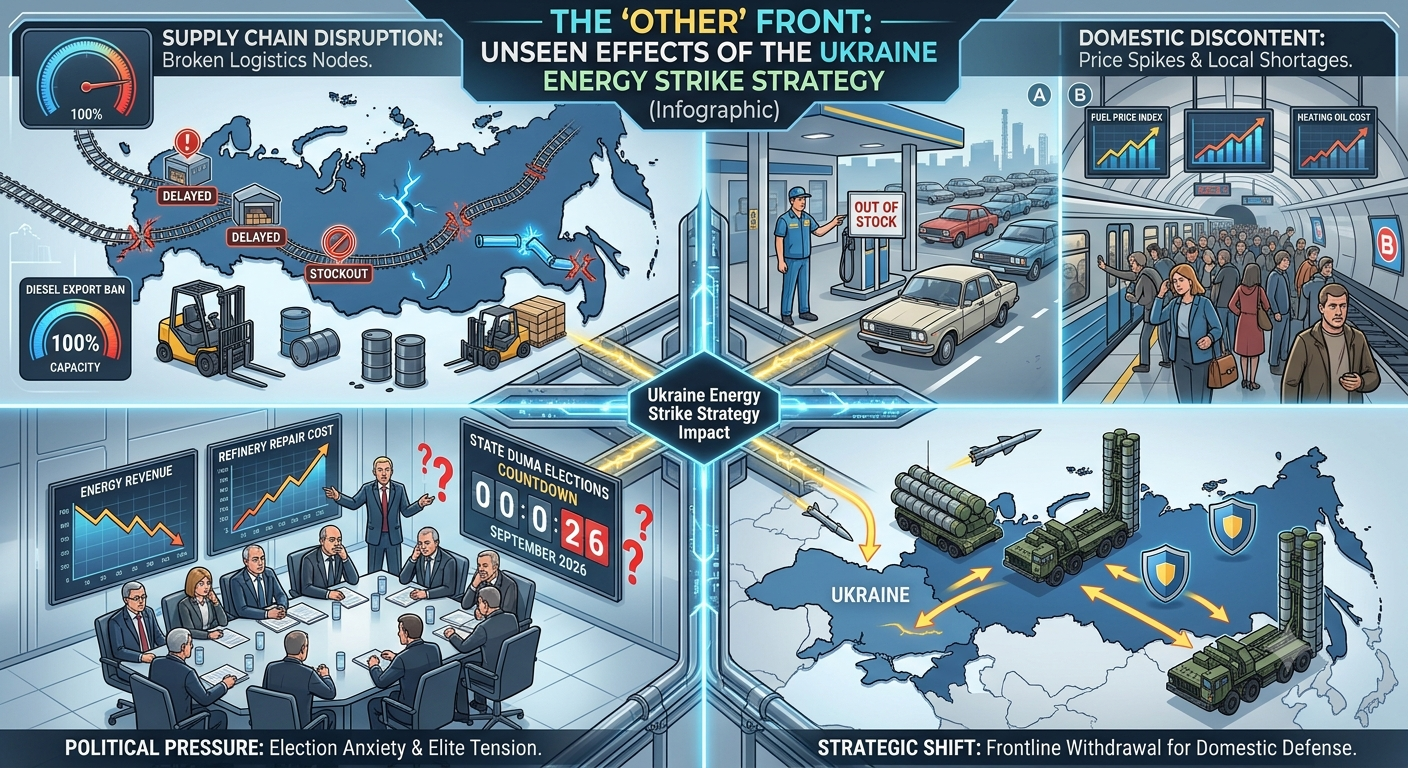
The Ukraine energy strike strategy is completely shifting the landscape of the war, bringing the conflict directly to the average Russian citizen living deep within the country. While frontline battles previously raged hundreds of miles away, daily life in major cities like Moscow went on largely uninterrupted. However, this asymmetric drone warfare approach cuts through military defenses to hit the literal economic fuel lines keeping the Kremlin stable.
But is this high-stakes approach yielding long-term results?
Ukraine has quietly but aggressively scaled up its long-range campaign, systematically targeting the lifeblood of the Russian economy: its massive oil and gas infrastructure. According to a deep-dive investigation by Fox News, this modern strategy is striking Russian production hubs at an industrial scale. Consequently, the ongoing operations are finally starting to crack the Kremlin’s carefully curated armor of domestic stability.
How the Ukraine Energy Strike Strategy Causes Fuel Shortages
Russia is widely recognized as one of the single largest energy producers on the planet, making the current situation highly unusual. Specifically, the federation is currently facing spreading domestic fuel shortages.
To keep its economy from spiraling completely out of control, Moscow has been forced to take drastic, reactive financial and trade measures. These moves include actively enforcing strict domestic diesel export bans and searching for external fuel imports. As a result, the resulting shortages are stretching visibly all the way from occupied Crimea deep into the Russian heartland.
Former Russian opposition politician and commentator Maxim Katz shed light on why these drone attacks matter so much during an exclusive interview with Fox News Digital.
“This is the first time that Russians actually see that the war has an effect on their day-to-day life — not only in the cost of fuel, but in its availability. You cannot buy it. And that’s a big deal for Russia.”
The Political Impact of the Ukraine Energy Strike Strategy
While the Russian military machine still gets primary access to oil stores to keep its front-line vehicles rolling, the expanding domestic shortage creates an ongoing political nightmare for Vladimir Putin.
Meanwhile, Russia is heading toward State Duma elections this September. While these highly controlled elections are neither truly free nor open, international political experts point out that they serve an important psychological purpose. In particular, they are structurally designed to project absolute executive control to regional leaders, wealthy business elites, and the general public.
When everyday citizens wait in massive lines just to fill up their cars—or find empty fuel pumps entirely—the illusion of absolute stability shatters. Therefore, if local public support visibly plummets due to everyday infrastructure pain, it forces the elite networks to question the long-term strength of the entire system.
For more context on the broader geopolitical landscape, check out our deep dive into
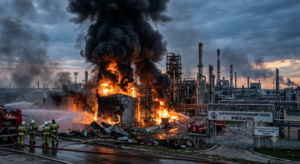
A large Russian oil refinery in Ryazan, Russia, burning with thick black smoke after a successful drone strike, demonstrating the effective Ukraine Energy Strike Strategy.
By forcing Russia to defend its own airspace and scramble for basic energy resources, Ukraine has successfully brought the war directly to Putin’s front door. It turns out that hitting Russia’s wallet and its fuel pumps might just be the most effective way to disrupt the Kremlin’s war machine from the inside out.
Source Attribution: The insights, data, and expert interviews featured in this blog post were originally reported by Fox News.
Luna focuses on the numbers that matter, whether that's a shift in interest rates or a game-changing trade deadline. Her coverage blends financial literacy with sports analysis, aimed at readers who want to stay sharp on both their portfolio and their bracket.