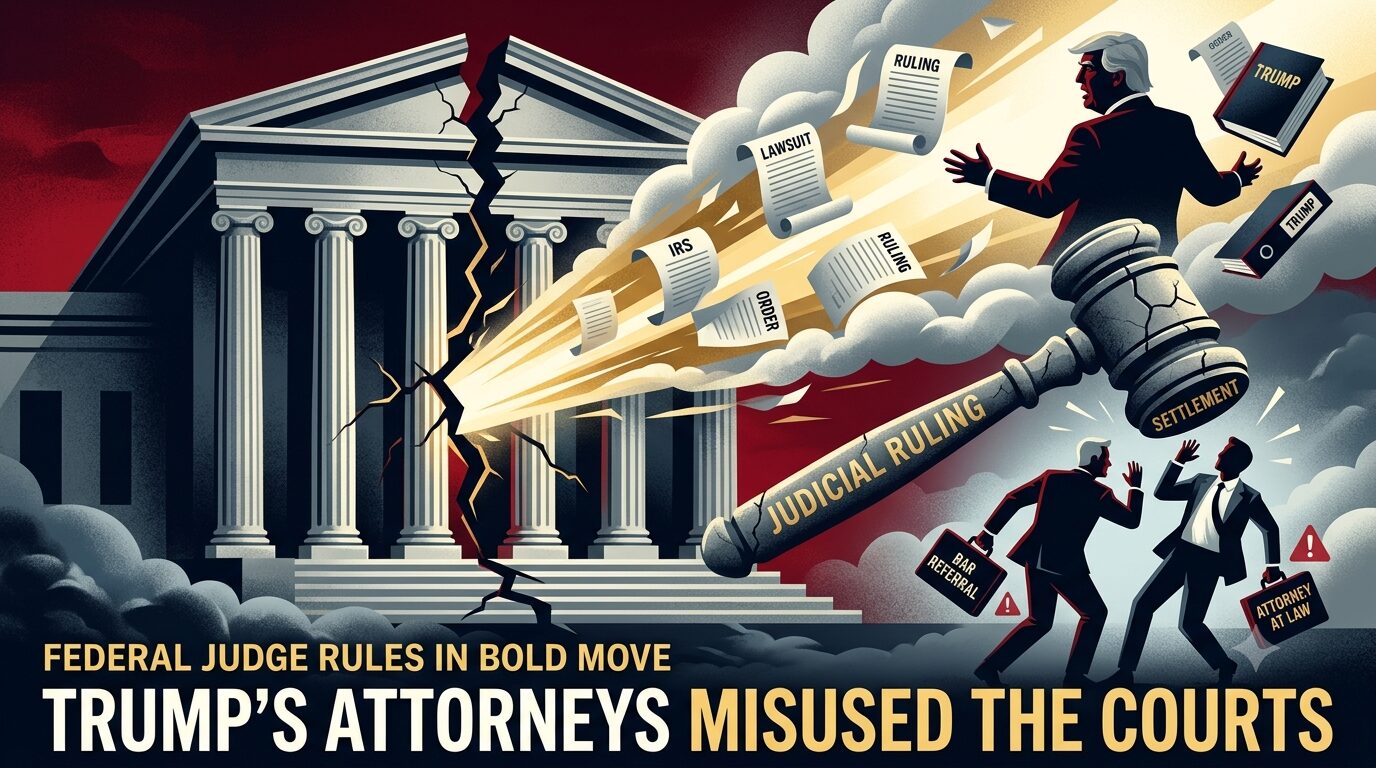

A federal judge recently issued a blistering ruling against President Donald Trump and his legal team. The court declared that the president’s high-profile lawsuit against the IRS was filed for an “improper purpose.” According to the ruling, the case was a bad-faith effort to misuse the judicial system.
Indeed, the legal drama has escalated quickly. U.S. District Judge Kathleen M. Williams nullified a controversial settlement agreement between Trump and the IRS. This scuttled deal had previously proposed a massive $1.8 billion “anti-weaponization” taxpayer fund. Because of these actions, multiple attorneys now face potential disciplinary action.
How Trump’s Attorneys Misused the Courts
Historically, federal courts require two opposing sides with genuinely conflicting interests to resolve a dispute. However, Judge Williams pointed out that this lawsuit lacked any real conflict. She noted that Trump brought the case against a federal agency that he ultimately controls as president. Therefore, the two sides were not truly adversarial.
Instead, the court found that the plaintiffs used the lawsuit as a tool. But why did they do this? They wanted to gain a stamp of judicial legitimacy for a highly unusual settlement. The judge wrote that the agreement had no viable basis in law or fact. As a result, she ruled that the parties acted in bad faith to bypass standard legal boundaries.
Furthermore, you can read the full judicial breakdown on the U.S. District Court for the Southern District of Florida website. The detailed 56-page order outlines how the parties manipulated the system.
THE COURT’S FINDINGS
| Lack of Adverseness | Both sides ultimately reported to the president. |
| Improper Purpose | Used the lawsuit to legitimize a private deal. |
| Taxpayer Impact | Attempted to earmark $1.8 billion in public funds |
Disciplinary Referrals for Trump’s Legal Team
Consequently, the attorneys involved in the case are facing serious professional fallout. Judge Williams referred Trump’s personal lawyer, Alejandro Brito, to the Florida Bar for potential disciplinary action. Additionally, she restricted the ability of attorney Daniel Epstein to practice in the local district.
But the penalties did not stop with the personal defense team. The judge also sent copies of her order to bar associations in New York and D.C. These copies target high-ranking Justice Department officials, including acting Attorney General Todd Blanche and Associate Attorney General Stanley Woodward. Both men had signed off on the settlement documents.
You can learn more about professional standards and ethics codes on the American Bar Association platform. These rules exist to prevent lawyers from abusing the court system.
The Fate of the $1.8 Billion Settlement
Originally, the lawsuit sought damages after a rogue contractor leaked Trump’s private tax returns. The contractor, Charles Littlejohn, was later sentenced to prison, as documented by the U.S. Department of Justice. However, the subsequent civil settlement went far beyond simple damages.
The agreement had attempted to permanently shield Trump and his family businesses from future IRS audits. Moreover, it sought to set aside $1.8 billion in taxpayer money for victims of “politicized” investigations. Because the court voided this agreement, those protections and the massive payout fund are officially dead.
Ultimately, this ruling sends a clear message. The judicial branch will not allow political figures to use the courts to validate self-serving financial deals.
For More Blogs Check Here