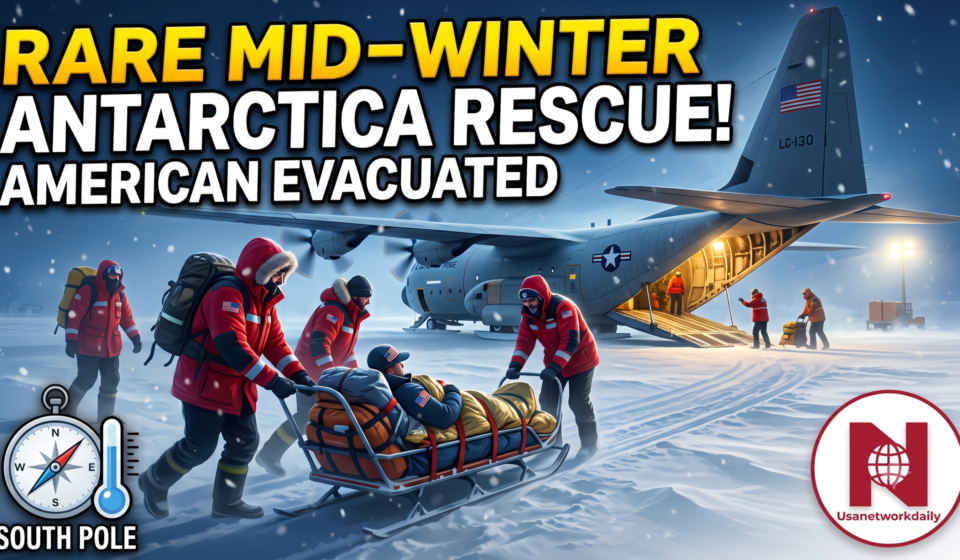

An American stationed at the U.S. McMurdo Station in Antarctica needed urgent medical evacuation this week. Getting them out meant flying into one of the most dangerous environments on Earth, in total darkness, in the dead of the Antarctic winter.
Here’s how the rescue actually happened.
What Happened?
The U.S. National Science Foundation, which manages the Antarctic program, requested help after an American expeditioner at McMurdo Station needed emergency medical treatment.
The NSF turned to the Australian Antarctic Division and the New Zealand Defence Force for assistance. The mission launched on July 28, described as an “urgent request for assistance.”
Why Was This So Dangerous?
Winter in Antarctica isn’t just cold. It’s total darkness, extreme weather, and ice landings all at once.
An early attempt on July 29 got delayed by severe weather. The mission finally launched on July 31, when a Skytraders Airbus A319, nicknamed Snowbird 1, departed Australia at 2:44 a.m. local time.
The flight reached McMurdo Station more than five hours later. Conditions on the ground were brutal:
- Complete darkness
- Temperatures as low as -45.5°F (-43°C)
- A narrow weather window that could close at any moment
Flight crews and medical teams worked fast to transfer the patient onto the plane. The mission departed Antarctica just ahead of deteriorating conditions, then flew on to Christchurch, New Zealand, where the patient was treated.
What Did the Rescue Team Say?
Crew members described the mission as right at the edge of what even specialized aircraft can handle.
Before the flight, the team reportedly ran through worst-case scenarios. That included a possible power outage at the airstrip, which would force a zero-visibility landing. The plane also carried extra fuel in case it couldn’t land at all and had to turn back to Australia.
One crew member described the workload as constant mental math, from cold-weather calculations to altitude corrections on approach, all while coordinating closely with the rest of the flight crew.
Is This Common?
No. Mid-winter medical evacuations from Antarctica are rare, precisely because the risk is so high.
This isn’t the first time it’s happened, though. In a separate incident, New Zealand’s air force carried out a nearly 20-hour mission to evacuate three Americans from McMurdo Station after they couldn’t get the care they needed on-site. One needed urgent treatment. The other two were moved as a precaution.
Officials involved in these operations have consistently described winter flights to Antarctica as among the most difficult missions they run, due to constantly shifting weather and the challenge of landing safely using night vision equipment in near-total darkness.
What Happens Now?
The American who was evacuated this time was admitted to Christchurch Hospital in serious condition, according to the National Science Foundation. No further details about the individual have been released.
Bottom Line
Getting one person out of Antarctica during winter took an international effort, a specially outfitted aircraft, and a crew willing to fly into some of the harshest conditions on the planet. It’s a reminder of just how isolated and extreme life at McMurdo Station really is, even with modern aviation technology backing it up. For more on how this story develops, check out [our latest world news coverage] on the site.
This article will be updated as more details become available.