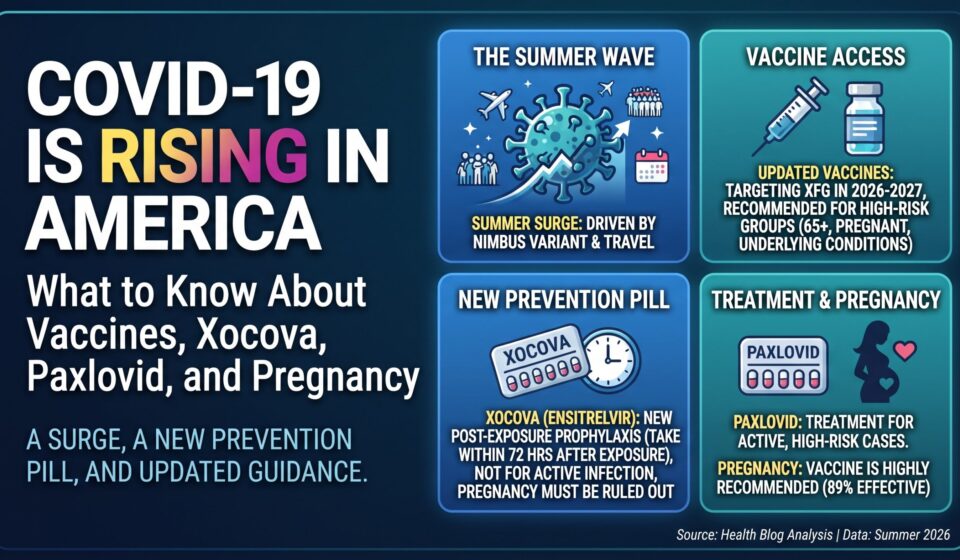

COVID-19 cases are climbing again this summer. A new variant and lower vaccination rates are driving the rise. Here’s what’s actually happening, plus a breakdown of the tools available if you get exposed or sick.
How Bad Is the Current Surge?
COVID-19 is now spreading across all four U.S. census regions. A variant known as Nimbus is driving it. The rise lines up with peak summer travel, too. Crowded airports, planes, and trains create more opportunities for the virus to spread.
It’s a similar pattern to what we covered in our recent piece on the Louisiana Vibrio vulnificus outbreak. Warm weather and travel both tend to accelerate how fast health threats spread.
Vaccination rates have dropped sharply, too. Just 17.5% of American adults and 8.9% of children got the 2025-2026 COVID vaccine, according to CDC data. That’s a steep decline from prior years. More people stay susceptible when cases start climbing.
Experts don’t expect a massive surge this time. Still, they recommend basic precautions, especially around travel and crowded settings.
What Is Xocova, and How Is It Different From Paxlovid?
Xocova (ensitrelvir) is a new tool most people haven’t heard of yet. The FDA approved it on May 29, 2026. It became available at select retail pharmacies nationwide on July 28, 2026.
It joins a small but growing list of emerging treatment options making headlines this year. Our coverage of the Candida auris superbug spread covers another one worth knowing about.
The key difference: Xocova prevents infection. Paxlovid treats it.
- Xocova works after exposure but before symptoms appear, within 72 hours of contact with someone who has COVID-19. It’s the first oral drug approved in the U.S. specifically for this kind of post-exposure prevention.
- Paxlovid kicks in after you already have symptoms and test positive. It reduces the risk of severe illness and long COVID.
Dosing differs too. Xocova involves three 125mg tablets on day one, then one tablet daily through day five. Paxlovid involves three tablets total (two nirmatrelvir, one ritonavir), taken twice daily for five days.
In clinical trials, Xocova cut the risk of developing symptomatic COVID-19 after household exposure by 67% compared to placebo. The most common side effects were headache, diarrhea, and cough.
One important note: Xocova isn’t cheap. It carries a list price of around $1,400. Many insurers don’t cover it yet, as of this writing. Doctors also stress it’s a backup layer of protection, not a replacement for vaccination. “Vaccine first,” as one infectious disease specialist put it. Xocova serves as a second line of defense after exposure.
Doctors should rule out pregnancy before starting Xocova. The drug also isn’t recommended for anyone with significant hypersensitivity to its active ingredient, or those taking certain medications metabolized by CYP3A.
What About the Vaccine Right Now?
This is genuinely confusing right now, and for good reason. Federal vaccine guidance has shifted multiple times over the past year.
The CDC currently recommends the 2025-2026 COVID-19 vaccine for people ages 6 months and older. That recommendation rests on individual, shared clinical decision-making between patients and their providers, rather than a blanket universal push.
Most people can still get it easily, though. Pharmacies administer about 90.5% of COVID vaccinations, without a prescription, and insurance typically covers the cost.
The Pregnancy Guidance Has Been Especially Messy
If you’re pregnant and trying to figure out whether to get vaccinated, you’re not imagining the confusion.
This isn’t an isolated case either. It fits the same pattern we covered in Trump’s executive order on spacing out childhood vaccines, where federal guidance and major medical groups have landed in different places. Here’s the timeline:
HHS Secretary Robert F. Kennedy Jr. initially moved to stop recommending COVID vaccines for pregnant women and children. That change rippled through CDC guidance for a period.
The CDC’s own vaccine advisory panel later reversed course. They voted that adults, a category that appears to include pregnant women based on updated CDC website language, can choose to get the vaccine after talking with their provider.
The CDC’s current official pregnancy guidance states plainly: COVID-19 vaccination during pregnancy hasn’t been linked to increased health risks for pregnant women or babies. It helps reduce the risk of severe illness, too. The agency also notes that most babies hospitalized with COVID-19 were born to mothers who weren’t vaccinated during pregnancy.
Medical groups have gone further than the CDC. The American College of Obstetricians and Gynecologists (ACOG) still recommends routine COVID-19 vaccination for anyone who is pregnant, trying to conceive, recently pregnant, or breastfeeding. They treat it as standard preventive care, not a shared decision to weigh case by case.
Why the extra caution for pregnancy specifically? The CDC classifies pregnancy as a higher-risk condition for severe COVID-19 outcomes, including hospitalization, ICU admission, and death. Despite that, only 11.1% of pregnant women had gotten a COVID-19 vaccine as of February 2026, according to CDC data. That’s a sharp gap between the recommendation and actual uptake.
Bottom line for pregnant readers: talk to your OB-GYN directly. ACOG’s guidance leans firmly toward recommending vaccination at any point in pregnancy, even as broader federal messaging has shifted toward a more hands-off, individual-decision framing.
What Should You Actually Do?
- Haven’t had an updated vaccine in the past six months? If you’re eligible, this window, before the surge peaks and before any fall vaccine arrives, is a reasonable time to consider it.
- 65 or older, or have an underlying condition? Talk to your doctor now about both vaccination and Xocova or Paxlovid, before you’re exposed.
- Test positive? Ask your provider about Paxlovid, especially if you’re in a high-risk group. Starting it early in the illness matters most.
- Pregnant? Talk to your OB-GYN directly rather than relying on general headlines, given how much the guidance has shifted this year.
Bottom Line
COVID-19 hasn’t gone away, and this summer’s surge is a reminder of that. Falling vaccination rates, a new antiviral in Xocova, and genuinely confusing federal guidance on pregnancy all add up to a lot to sort through.
Still, the throughline from health experts stays clear: vaccines remain the first line of defense. Xocova and Paxlovid serve as backup tools after exposure or infection. And pregnant readers should lean on their own OB-GYN’s guidance, given how unsettled the federal messaging has been. For more health coverage like this, check out [our latest health coverage] on the site.
This article will be updated as vaccine guidance and case data continue to evolve.